[yellow, a finger up, looking smug]
The answer to oppression is NEVER violence
Turn the other cheek
Pacifism always wins
You could earn rights by asking nicely instead
[yellow, proudly showing us a huge book]
Don’t believe me?
Open a history book!
[yellow, looking frustrated as they are shuffling through the book’s pages]
Ok so…
Uhm…
Not this page…
Wait…
The next one…
Awkward…
Another…
Yeah but…
For sure this time…
[yellow, sweating, protecting their book, a hand raised towards us]
Can you stop looking?
You’re being rude
That’s my book
https://thebad.website/comic/please_resist_responsibly
For best results, you need a trifacta.
A popularist movement is core. This should be non-violent and as welcoming to new members as possible.
A political group then acts as a focus for the group. It translates the mob grievances into politically actionable demands.
A radical group acts as the teeth. It forces the government to take proper notice of the other 2 groups.
The Irish troubles would be a good example. The popular movement was ignored by the UK government. It bubbles over into riots etc at times, which actually hurt their message in many ways. The Sinn Féin party focused the discontent and gave the UK government someone to negotiate with. Finally the IRA provided the force on the UK government.
Take away any leg and the whole movement stutters. If the popularist wing gets violent, then it bleeds members fast. Without a political wing, the movement is unfocused and will achieve nothing. The violent wing can be dropped IF there is sufficient threat of its existence/creation to keep governments motivated. Unfortunately, most governments that let things escalate that far will just dig in their heels, rather than do the sensible thing.
That’s a well done analysis, thanks for the insight.
If a person wanted to learn more about this idea ans others like it, what should i go searching for?
Another important aspect is that the radical group isn’t denounced by the popularist or political group. They don’t have to be friends, but they can’t be enemies. What I’m seeing these days is protestors actively shutting down any potential violence from their side, self-governing to the point where the people in power don’t have to do anything to keep the whole thing in check. Without that fear for their life, the people in power can ignore the civil resistance members while allowing them to keep their more violent peers in check, along with a bit of police presence for good measure.
Agreed, but with a few provisos.
Turning a peaceful protest (march etc) violet is a big no no. If there is seen to be a risk of this, the popularist section will rapidly hemorrhage members. The radicals can use the events as cover/meeting new members, but not go hot on the march. The exception to this is if the government/police go violent. Defensive counter violence is then acceptable. The goal should be to get the “civilian” supporters (think families etc) clear. Then, it’s down to them whether they bolt too, or play whack a mole with the police.
The other proviso is that the radical groups actions should be proportional. The IRA walked this line. When they set major bombs, they gave the authorities enough warning to clear the area of civilians. They were mostly aiming for property damage and disruption, not mass casualties. The times the IRA went past that line did severe damage to their reputation. They need to act to reinforce the position of the other 2 groups, not undermine it.
Thank you for pointing out that the radical flank theory usually omits the political, more conservative, flank to the right of the mainstream group.
In an examination of 323 violent and nonviolent resistance campaigns, between 1900 and 2006, nonviolent campaigns achieve partial or full success at twice the rate of violent campaigns
The first quote you pulled requires the preceding sentence for context.
Despite these assumptions, from 2000 to 2006 organized civilian populations successfully employed nonviolent methods including boycotts, strikes, protests, and organized noncooperation to challenge entrenched power and exact political concessions in Serbia (2000), Madagascar (2002), Georgia (2003) and Ukraine (2004–05), Lebanon (2005), and Nepal (2006). The success of these nonviolent campaigns—especially in light of the enduring violent insurgencies occurring in some of the same countries—begs systematic investigation.
The second quote you pulled merely precedes an explanation of how the authors attempted to address the difficulty of separating violent campaigns from nonviolent campaigns.
In many cases, both nonviolent and violent campaigns exist simultaneously among different competing groups… To address these difficulties, we established some standards of inclusion for each of these categories. The list of nonviolent campaigns was initially gathered from an extensive review of the literature on nonviolent conflict and social movements. Then we corroborated these data using multiple sources, including encyclopedias, case studies, and a comprehensive bibliography on nonviolent civil resistance by April Carter, Howard Clark, and Michael Randle. Finally, the cases were circulated among experts in nonviolent conflict who were asked to assess whether the cases were appropriately characterized as major nonviolent conflicts, and also which notable conflicts had been omitted. Where the experts suggested additional cases, the same corroboration method was used. The resultant data set includes major resistance campaigns that are primarily or entirely nonviolent.
deleted by creator
Sure, and where does diversity of tactics rank?
It’s rarely one or the other, eg. Suffragettes demonstrations were made much more threatening by the bombing campaigns that were happening in parallel, Gandhi was made much more threatening by the HSRA campaigns, MLK wouldn’t have achieved jack without urban uprisings and the black panthers turning up the pressure in the background, etc.
We’re rapidly heading towards an inflection point where no amount of town halls, lawsuits, etc will fully halt the wave of destruction. So while these resistance campaigns are needed and should continue, how long are they going to work within the part of the timeline where democracy and all of the mechanisms have been fully eroded, reversed, and proven to be placebos?
I still find the meme funny, even if this is all far more nuanced. Some examples:
- A lot of cities are rejecting and shutting down Flock cameras, but in some cases the cameras quietly returned after the uproar died down. They simply waited for people to forget. At what point does it become justifiable to either cover all of the lenses or destroy them altogether?
- Similar with data centers. The billionaires are going to keep pushing them through, and in one case I saw recently, a town’s leadership even overturned votes against data centers, which was a clear-as-day example of democratic erosion. What good is democracy if it can be arbitrarily overridden? At which point is it justifiable to try and destroy a datacenter’s functionality in order to preserve life, especially when future generations are at stake?
I think eventually we’re going to need a combination of both, but it needs to be lead with structure and intelligence. Billionaires are going to continue to erode and ignore democracy, while a bunch of city officials will continue to fold to the almighty buck, similar to how AIPAC has turned tons of politicians into useless genocidal drones. We’re going to be pushed into a corner where we can either fight back with everything we have access to, or we can keep pulling on levers they’ve systematically destroyed in order to nullify our democratic power. It could be 5, 10, 20 years from now. We don’t know when but authoritarianism—especially now in such unknown times—makes it inevitable.
The TL;DR here is that we need to clearly define what counts as violence. Destroying Flock cameras and hindering data centers is in the same bucket and it’s self-defense, but it’s not violence in the sense that we think about it. If someone automatically thinks that “violence” means “overthrowing the government,” they’re willfully (or maybe not; probably a good time to educate and share knowledge with fellow working class folks) ignorant to a whole bunch of smaller, more focused acts.
Other examples:
- Chat Control in the EU (passed the parliament after numerous failed attempts even though a majority voted against it)
- The SAVE Act in the US (passed the House after numerous failed attempts through an unrelated “must-pass” budget bill)
- Canada’s Bill C-22 (hasn’t passed yet, but the mass surveillance apparatus wants to push it through)
- Not putting Trump and his co-conspirators in prison after the January 6th violent coup attempt
- Not prosecuting anyone from the Panama Papers (which seems to have been almost entirely forgotten in the public view)
- Not prosecuting or arresting any of the Epstein criminals in the US
And those are just very recent examples.
I appreciate you expanding on examples. All of this paints a clear picture, and even Peter Thiel has said the quiet part out loud: the ruling class see democracy as a problem because it prevents them from owning everything and keeping us as wage slaves.
and keeping us as wage slaves
That’s just an intermediary goal. The end goal is actual slavery.
Eh, I’m not so convinced. Capital didn’t allow slaves to be replaced with paid laborers out of the goodness of their hearts, but because slavery became obsolete - it’s simply less profitable.
If you’ve got a bunch of enslaved workers, not only do you have to keep them alive (i.e. provide some minimal amount of food/shelter/medicine), but you also have to keep them in line and prevent them from just running away. That means you need to employ guards (enough to stay above some minimal ratio of slaves to guards), which is an additional cost. Not to mention that people generally don’t enjoy carrying out forced labor, so your slaves will likely not be as productive as possible.
Now, if you take the same group of slaves but convince them that they’re “free” and are performing voluntary labor in exchange for some form of monetary compensation, the whole equation changes. You can just pay each “wage slave” the same amount that you would have been paying yourself for necessities, plus maybe a token amount on top so that they can occasionally access a little bit of luxury and keep morale up. You don’t have to pay to maintain a guard force (now the guards can also be employed as ordinary laborers, increasing your labor pool!), and workers will probably be more productive on average since they get to feel like they’re getting something in return for their effort. It’s literally just more cost-effective than slavery - the former slaveholder has fewer costs, lower risk of their workers revolting, and better performance per-worker.
The calculus got a bit imbalanced for the better part of the last century, since the rapid and continuous economic growth throughout much of the world (the Western imperial core in particular) meant that there was enough surplus that workers could actually sustain a decent level of luxury expenditure on an ordinary salary. Now that growth is slowing down Capital is just clawing back the territory it allowed to get taken during the glut. I don’t see us returning to actual slavery, but something more like how things already are for much of the working class across the imperial periphery and developing nations (or like things used to be in the imperial core; think British factory workers in the mid-late 19th century): shitty working and living conditions, and long working hours in exchange for barely enough pay to scrape by.
True, but things could change again, slavery could become profitable again.
Maybe just starting with getting paid in some cryptocurrency company scrip, maybe made profitable because they can use robots and surveillance as guards, etc. But I don’t think they’ll ever be truly satisfied with wage slaves. They begrudge every single penny they have to part with in wages.
How could slavery ever become cheaper though? You need some type of guards/supervisors to keep the slaves from just leaving. I guess you could get rid of that and just entice laborers by offering shelter, food and other essentials in exchange for work, but that’s not really the same thing that people generally mean when using the word “slavery” - it’s a 1950s-era coal mining town in West Virginia. Unless someone develops a way to get people to continue working for less than the bare minimum they need to scrape by (i.e. the workers all die of hunger, disease or exposure), there really isn’t a way you can get away with lower cost per worker than by using wage slaves under capitalism.
Looking at their chart near the top, it appears as if violence scores higher in most categories except for “non-violence security force defections” which eclipses every other datapoint by 20x-40x which probably realllly skews the average in favor of non-violence.
As usual, nonviolence only works if enough of the opposing force is not ruthless and unscrupulous.
Don’t show him facts now, you’ll scare him!
How dare you dispute the genuine value of this conversation that literally has never happened!? We need to other anyone who disagrees with us by way of making a ridiculous and disingenuous caricature of their viewpoint! /s
Public Education in the US LOVES Martin Luther King Jr.
Barely ever any mention of Malcom X.
I hold that nobody would’ve listened to MLK if the alternative wasn’t Malcom’s approach.
The Black Panthers did more to advance gun control laws than any “radical left hippie kumbaya” ever did. Let minorities have the same freedoms and suddenly things need to be toned down for everybody.
The black panthers had guns and actively leaned on people, they courced people, with VIOLENCE.
and it worked, maybe people citizens should do the same.
Exactly my point.
I think the only time “Black Panthers” was mentioned in my 13 years of public education was when somebody asked a random question about Forest Gump.
yah but iv noticed a trend with Americans, they are obviously afraid of their own state, they seem to actually think their police and army are unbeatable (no they’re fuckin not and you have close access to their production facility for easy destruction) but for some fuckin reason, they wont do it. im sorry but if they wont fight for themselves, they deserve the Yoke. especially since they’ve falsely be crying about democracy and freedom for decades, i don’t think Americans realize how bad their reputation is outside of america.
Workshop: arguments for keeping the fourth panel? I feel like ending on #3 is a lot stronger.
I think you’re right.
Thanks, useful advice on writing/pacing is rare.
It definitely feels risky giving unsolicited feedback, because maybe it’s not wanted.
I also wonder how much of my fear was shaped by r/comics somewhat brutal and arbitrary moderation. I think there was an explicit rule about not saying anything negative, as if the sub were a site to encourage women to take photos of themselves.
There’s good and bad ways of giving feedback.
Yours is very good.
Other people’s, often not so much.
i like the fourth pabel. it shows someone loudly proclaiming the status-quo establishment line, being shown to be embarassingly, catastrophically wrong, and rather than changing their ways, their worldview, or owning up to their mistake, they change subject, deflect, and get defensive. i think that’s a well-observed comic panel
Oh, yes, panel #4 is definitely true and I do enjoy looking at that guy freaking out; I just think it’s making a second point (how claims are defended in the contradiction to the evidence) at the expense of the first point (that this claim is in contradiction to the evidence).
You can make both points, of course, but the last one is the one more likely to be remembered.
great point, very thoughtful response
Peace is only an option when the social contract is maintained.
When power structures violate it or make sure you’re excluded from it, it’s time for bricks
The real reason MLK Jr is posthumously a hero.
I too would have an easier time achieving major changes through non violent means if I had my jojo stand Malcom X standing menacingly out of sight behind me at all times threatening more violence and more uprisings if my peaceful demands were not met.
Malcolm X posed as MLK j(oesta)r’s stand is an amazing image lmao
Ghandi too
deleted by creator
You want your rights?
You have to be willing to throw bricks.
BRICK BY BRICK
Marsha P. Johnson couldn’t have said it better.
FYI, there is a difference between nonviolence and pacifism. Pacifism opposes violence altogether and is predicated on the idea that there is a peaceful way to settle all disputes. That is to say, it’s a philosophical or ethical position. Nonviolence is a strategy to achieve your goals without employing violence. Nonviolent protesters do not take violence off the table altogether. Rather, they believe that violent actions are not as likely to achieve their goals as nonviolent action would be.
In general, nonviolent action is taken by groups who are opposing an oppressor that has a significant power advantage over them. By resorting to violence immediately, they play into a game that they are destined to lose. Instead, they strive to use nonviolent means to make their struggle impossible to ignore. It relies on the oppressive system being vulnerable to a change in public opinion. In general, it also involves an implication that they may someday resort to violence if things do not change. That is, it differs from pacifism in that it does not deny that violence may be necessary.
Unfortunately, the idea of “then we go into the board room and execute all those assholes” has a certain emotional appeal that’s absent from “we’ll boycott, vote, run better candidates”.
More active resistance like strikes or blocking production are a little more poetic, but tend to draw violence
History be like:

It depends at what stage of oppression we are in. There’s a point for both a soft touch and for violence, wisdom is knowing what to do and when to do it.
There is liberal anti fascism and autonomous anti fascism. Liberal (e.g. using lawsuits) anti fascism is good, but never enough alone.
You have to deny fascist speech, because fascist speech equals fascist recruitment. You have to deny them platforms. The early age of the internet made that impossible, and many nerds like me had no clue about this. Freedom of speech warriors against stupid governments etc. Much of that was correct, but what got forgotten is that you need active moderation and laws to limit hate speech from proliferating. And neoliberal governments never pass those. Like fascism, neoliberalism believes in inequality.
This current wave of fascism is a long time in the making with the ultra conservative and christian talking points and rural talk radio. When talk radio started ranting against abortion, THAT was the time you should have started autonomous action to stop their continued broadcasting abilities.
I learned the political theory for anti fascism way too late. This is a good book review on this.
What about like 10 years after that inflection point?
Of course some areas are seeing an increase in physical violence and build up of arms on both sides. Fortunately or unfortunately the side that wins is the one with more money, infrastructure, resources, and political influence regardless of overall societal wellbeing. So if someone is going to fight they need to plan, wars are won or lost long before the first shot is never taken.
You are at the paint the streets red stage or you are going to be enslaved.
Which country are we speaking about exactly?
Can’t trial legally? Ball chipper time.
Your just a coward too scared to actually nut up and pick up a gun or destroy billionaire assets, nothing more.
I’ve always wondered why like 20% of Lemmy users are so agro. We can speak to one another like reasonable people.
We tried that and you idiots are still going, "what it we protest. " like a Bunch of spineless tits.
if protesting worked, Donald would have been stopped by now. If you won’t fight for yourselves, Y’all deserve the yoke.
I’m more so talking about you in particular and people like you on Lemmy who seem so needlessly aggressive. We can speak to one another like civil adults.
can you guess who i was talking about, im sure you can.
also “civil” more like spineless, the aggression is a necessity if you don’t want to be subjugated, like the meme says, open a history book and see what’s happened to those who didn’t resist without at least the Coercion of violence looming.
I’m not saying aggression is never necessary but bro we’re just talking on Lemmy, chill. Go have a soda or a good fap or something.
im not as interested in those passtime as you might be, don’t get snarky. as i said the time for protesting has long passed as its proved whole ineffective to the federal government and vandalism of donalds allies asset books is the next step, but iv seen little in the way of that.
The ruling class didn’t get to be the ruling class by being convivial. If you want a peaceful, classless society you need to treat it like a bonsai tree: occasionally you must nip things in the bud.
Prisoners dilemma. Turn the other cheek all but guarantees oppression. Cooperation, and tit-for-tat (swift rebuke + forgiveness) wins
You are correct in the swift rebuke + forgiveness wins. I remember reading about that when some people were war gaming during the Cold War.
Nonviolent India Independence Movement
Looks inside
A shit ton of violence
I don’t know much about Gandhi but didn’t the British grant independence to other countries just as they did to the Indians(ok, probably better than they did it with the Indians)? I mean they just couldn’t support their troops due to the ww2. Would it be violent they would have probably left sooner. If there was no peaceful independence movement at all, well they did leave like that in other countries. So I don’t get Gandhi praise, it’s not like he did anything(also he was a pedo).
Yeah they left because the British empire was collapsing during and after WWII and they knew they would be unable to sustain their presence in India, especially with the rising violence and massive population.
Gandhi had been campaigning for 20 years, but it didn’t have any effect until the British quite literally ran out of steam with zero other options.
If Churchill had won a reelection, it’s likely he would have gripped the remaining colonies for longer which probably would have ended more bloody.
Jinnah saw all the sectarian violence go unresolved under British rule and pushed for an independent Pakistan knowing it wouldn’t just magically disappear after the British left.
Gandhi ironically was assassinated by Hindu extremists for “allowing” Jinnah to succeed in making Pakistan, and now those same extremists make up the current party in power in India.
The joke is that no nonviolent movement ever really succeeded because of the non violence. India and Pakistan gained independence because the British couldn’t control the onslaught of uprisings in their colonies. The civil rights movement succeeded because the government was afraid of violent public outbursts if they didn’t start making serious law changes. Even more irony, MLK was also assassinated.
Both of those events were taken out of historical context and then presented as if nonviolent action was the major cause of change when in reality it was just one part of a much bigger picture.
Pinochet.
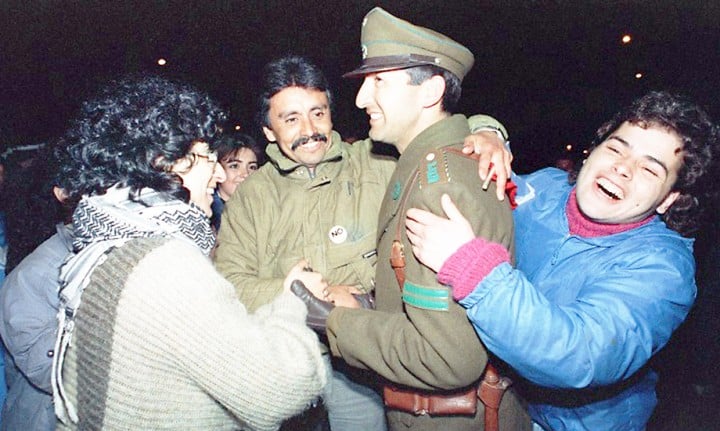
That’s the best example, he was defeated by people basically singing and dancing and telling him NO In the polls.
As horrible the dictatorship was, I love deeply and profoundly the wholesomeness of how that monster was brought down, I always like to listen at the NO’s campaign when I feel sad or depressed because it just gives me so much hope and joy.
That also relied on the military NOT pulling a Tianemen Square Massacre.
Basically the ones in control of the violence agreed with the public, meanwhile the American brass has been getting shuffled around like nobodys buisness.
they kinda tried tough.
deleted by creator
there is a lot of unpack here, a lot of it is kinda quite untrue.
Pinochet died in house arrest in 2006 while on trial, yes, justice wasn’t really made he died of old age before being jailed by his crimes, thanks to the scumbag of Frei Jr.
But the thing is that Pinochet did wanted to claw onto power, at least up to 1997, he tought he gathered legitimate support amongst the poppulation and decided to try to win cleanly to appease the international pressure, (it wasn’t so far fetched, in the 1988 plebiscite he got 42% of the votes, and won in places like araucania).
And when the old guard managed to defeat Pinochet on it’s own game, history records that Pinochet wanted to do a self coup d’etat and not to recognize the results, but the other junta generals, seeing the writhing on the wall, moved faster, and that’s how you have General Matthei telling the press that the NO had won to the press, while on it’s way to the meeting on wich Pinochet supposedly wanted to plan the coup.
Democracy came back, Chileans were free once again, and the leader of the Opposition, old guard politician, Mr Aylwin, became president.
At the very beginning of democracy there was a strong desire for national reconciliation (see protestors/No victory celebrators hugging cops image), Chilean society was torn apart and people wanted to reunite (remember a 40% still supported Pinochet at the time), but as the truth started to came out, of the heinous crimes that happened during Pinochet, the desire for justice became way more important, but it took a long time, all the politica and legal infraestructure they set up to protect themselves had to be dismantled, but it was, and they started to be prosecuted See this hilarious clip of the director of the secret police being arrested (to wich they reacted by threatening the Aylwin’s govt with a new coup), wich added to the fact that the, now opposition, right wing, still tried to defend many of them, made it slow.
The international support never existed outside the US, there always was international solidarity for the Chilean cause for freedom and democracy, and even in the US, the support went away fast after they impeached Nixon, by 1988, when the plebiscite was, the regime was already accustomed to being an international pariah, something the NO’s campaign even mocked him for.
But overall, there is nothing i love the most in this world than the NO’s campaign, and how they promised chile that they could vote without fear, and that they could dream for a future in wich people could be free, A joy that would come, if they voted NO.
Aaanyways, Greetings from chile, a country where i was fortunate to be born, and to be born free and in democracy because my grandparents and parents voted NO that day.
deleted by creator
“The people in charge insist that rising up physically against the people in charge is always wrong, and so they’ve made rules against doing that, or suggesting it online, or making any sort of plans to do it. As always, the folk with all the money and power have all of our best interests in mind.”