cross-posted from: https://discuss.online/post/47043755
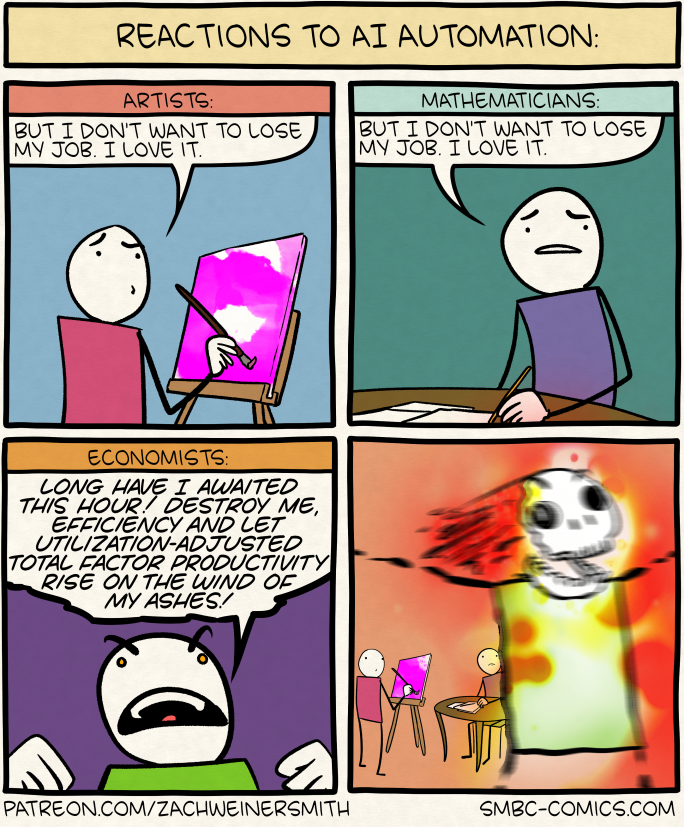
http://www.smbc-comics.com/comic/reactions
Alt text
Meanwhile the Engineers are just lighting themselves on fire to see what happens.
Bonus panel
I love it
Artists I know: I dont care people with a make think they can make music for years…
Mathematicians I asked: and people where anxious about the calculator… Math will never be done and a computer cannot held be accountable for false answers, so we still will be needed.
Economists I know: who are you and how did you got into my house? I dont want to see that! hey gimme back me phone I am calling the Police!!
Economists are a religious sect for modern times: divining what will and what won’t happen in a completely arbitrary, selectively enforced system. They’re a class of citizens that attempt to legitimize political want and behaviour.
And programmers are split between the top and bottom row
As someone within this field, yup, lmfao
Me and all of my friends within compsci are all “yeah but I love my job” and they all talk about their co-workers who seem to hate programing and problem solving
And unfortunately it’s really starting to seem like I have to start using LLMs as part of my job to keep up, and it’s so sad
Really shows the difference between the “I like problem solving” crowd and the “I like shiny tech and everyone said this would make money” crowd.
What about the “I like shiny tech and problem solving” crowd?
I’d say I actually fall in that camp. Right now I’m trying to set up an open source AI assistant that’s like, a little dumb but can still help me while I’m coding.
My ideal relationship with AI is this image:

But the shiny tech makes problem solving so much easier … for me. I can now much more easily solve problems on a wider scale. Many problems I solve are sprinkled with side tasks that don’t have directly to do with the problem but are in my way to get to the solution. Those things have cost me a big amount of time in the past and just bothered me (because I needed to deep dive into something that wasn’t what I wanted to work at). Now an agent deals with these pesky things much faster and I just have to clean up, while keeping my focus on the actual thing I wanted to solve.
You and I have a similar workflow. One thing AI solved for me is not having to hunt obscure specific documentation or wade through unhelpful forums. It also helps make a test script for when I want to see if something’s working without another 20 minute sidequest.
I’m mainly referring to the people who want the AI to do all the work, which has unfortunately become a common expectation lately. Some people want to feel like programmers without ever reading or writing any of the raw code.
Yeah. Every now and then there’s a misguided artist spewing shit like “engineers” or “programmers” are all out to get them because they love AI so much.
Fuck that, I do love my job, I hate both AI “art” and “code”, and I know plenty others.
They are, though.
No. Some are, that’s my point. And probably not even close to the majority of us.
Ah yes, economics: the worst branch of the social sciences.
Try Thomas Piketty, or Emmanuel Saez. Or if you want someone older, try Jean Jaurès. Just because rich people love sociopath economists doesn’t mean there aren’t good ones out there.
[edit: adding a snippet]:
Together with economists Thomas Piketty and Gabriel Zucman, Saez’s work claims top earners in the United States have taken an increasingly larger share of overall income over the last three decades, with almost as much economic inequality as before the Great Depression. Saez recommends much higher marginal tax rates, of up to 70% or 90%. Among other honors, he received the John Bates Clark Medal in 2009 and a MacArthur “Genius” Fellowship in 2010.
I’d be happy with calling them economic anthropologists, haha. As far as I’m concerned (and I’m sure it’s more complex than this) the ones interested in people are anthropologists and spreadsheet humpers are economists. But I respect them swimming upstream in their field, being surrounded by economy bros has to suck so hard.
The loudest economists use economic theory as a cudgel. You are right to find them infuriating. They assert certainty where economics does not, and cherry pick exceptions to hold up as rules. They are to economics as RFK Jr is to medicine.
The math of economics is more like the math of epidemiology or fluid dynamics than the math of mechanical linkages. It describes how things tend to interact within a system, but a given element or interaction is unpredictable. Even concrete sections, like price theory, have contradictions like the velvet rope effect. It describes probable outcomes in a chaotic system running on irrational humans.
Meteorology is still a math-based science that makes useful predictions, even though it cannot say with certainty whether a particular tropical depression will become a hurricane.
it’s not science, it’s excelology
Psychology definitely worse
I can confirm. It’s gotten better in the last few decades, but it’s still pretty horrific. Much worse than economics. (Obviously it is still a fascinating field and there is a lot of good, interesting, scientific psychology. It just also very much has its problems)
This is a banger.
Economists about to find out that everything they thought they knew is wrong.
Another relevant SMBC comic:
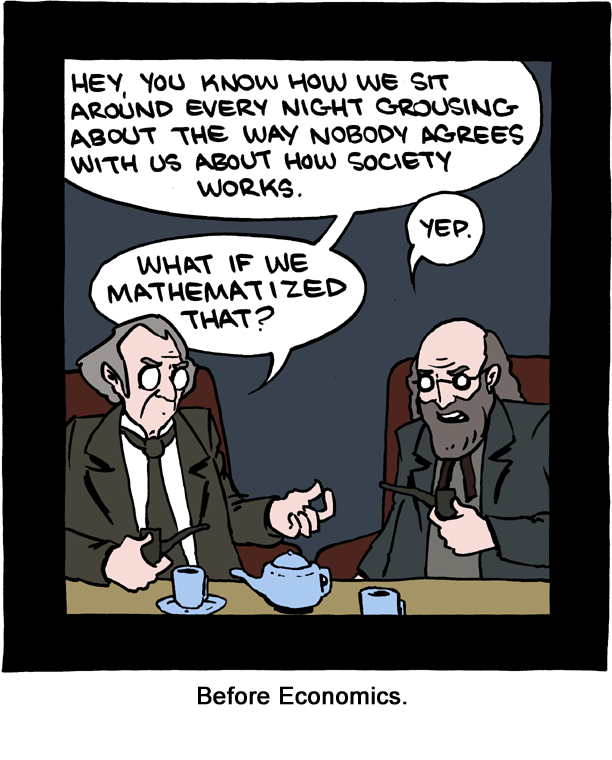
Economics is soft science pretending like it is describing fundamental laws of the universe.
Economists don’t know shit, they are describing how the economy could work in certain conditions in a vacuum and sometimes politicians/business people buy into the fantasy to backup doing whatever they wanted to do in the first place.
Oh shit, it’s religion again.
Das Kapital should be required reading for all economists
It could be (I’m not saying I know this to be true) that the version of “economics” that makes it onto the TV news is the one that capital finds the most useful, not the version that’s the most scholarly or serious. Or interesting.
There is an element of this, because the people using it for policy or writing headlines always disregard a ton of caveats and qualifications in any field (including actual hard science like physics), but most economics texts I’ve read hide a ton of complexity behind “rationality” that doesn’t exist and are implicitly describing the system that we have (capitalism) without acknowledging that we could do it any other way - which frees them from any ethical conflict with capital/exploitation and lets them pretend they are describing a natural system.
The truth is we are irrational both as individuals and as groups with outside influences, and the economy can function in whatever way we want it to function. In that lens economics quickly turns into psychology, ethics and philosophy. Which, to be clear, would be a useful thing to study in any economic system (all of which have incentives and pitfalls), but it is not nearly as objective or concrete as it currently pretends as it fiddles with interest rates while billionaires run roughshod over our entire society.
There’s a famous quote about economics that goes something along the lines of “the market can remain irrational longer than you can remain solvent,” which I think summarizes everything pretty nicely. Humans are chaotic and largely unpredictable creatures, and economics is a science devoted to trying to pull deterministic data out of inherently nondeterministic people. Sometimes they’re even pretty on point about it. But in all cases it is, best case, an educated guess.
yeah, i like to shit on macroeconomists because their best model (that is quantifiable) is only like 60% accurate. there’s not a lot of predictive power in it, but the various models they use are accurate enough to illustrate general ideas.
i also like to shit on microeconomists because they study auctions and that’s about it. also there was that month we all (like, every economist) studied bananas. i swear the entire damn field has ADHD.
then there’s the austrian school, who are afraid of maths.
i guess my point is that the field of economics is wide enough to fit at least three asses


To play devil’s advocate, sometimes the economists’ “math” forecasts bad news; in which case politicians/business people will plug their ears like with anyone else. It certainly doesn’t help that economists can’t forecast when things go pop.
To imply anything other than “line-go-up” would imply a bad job on the part of a politician/business person. Which of course, would be ludicrous. 🙃
deleted by creator
You can debate them if you like, but you better be citing your sources, which are them.
Sadly mathmeticians took a bit of time to grasp it
Parts of art have long been industrialized. Prefab and flat packed homes and furniture. Minimal decorations.
Now it’s the turn of digital art. Physical art is still there.
Most hard sciences had already been industrialized as well. Mathematics is the latest to join. Mathematicians need to reinvent what they do: mountain climbing (proof creation) might be dead but theory crafting and increasing understanding (novel proofs) will never be.
Mathematicians need to reinvent what they do: mountain climbing (proof creation) might be dead but theory crafting and increasing understanding (novel proofs) will never be.
This is a pretty easy mistake to make when you don’t have firsthand experience, but the problem is that’s not a reinvention of what mathematicians do at all, it’s only a reinvention of the presentation. Big mathematical advances are almost invariably driven by curiosity, but the university writing your paycheck wants their name attached to yours in publications of breakthrough results. Proofs are just the way a mathematician justifies that they’re working on math. No proofs means a risk admin will triple their teaching load and say “you’re only getting paid to teach now” with lip service about encouraging them to continue math on their own time.
If you have an oracle that gives a true/false answer to a conjecture, it won’t destroy a mathematician’s curiosity to ask why, but it will absolutely affect his ability to convince the admin that can’t even read the abstract that this pursuit is worth funding. That’s the crisis. Math papers are unreadable without years of study training your brain to think that way. A headline of “AI proves big theorem” is likely to win over a public that’s grown up disliking math because of its use as an educational gatekeeper, even when it’s unrealistic for human mathematicians to verify the AI’s claim. There is a very realistic risk of administrators who can’t define what a topology is declaring that mathematicians are obsolete.
The final answers to whether conjectures are true/false have never been the fruit of mathematics research. Think about Grothendieck’s work towards solving the Weil conjectures - the machinery he developed to solve them is modern algebraic geometry, world-changing stuff that’s become the backbone of cryptography among other things. Learning the conjectures are true is a footnote. If everyone had already known they were true in advance though, no one would have paid him to start working on them in the first place.
It would be like someone telling you we can finally stop playing your favorite sport now that the games can be simulated, but you try convincing them otherwise when they’ve never understood one rule and never put a game on because they’ll just be confused and bored.
I pretty much agree with most of your comment. Grothendrieck’s work would be theory crafting and the curiosity point is similar to what I was thinking when writing about novel proofs/increasing understanding