


Anubis, tho the transaction is so quick I can’t 100% confirm that, but I think they do
The amount of time which Anubis and other PoW-based algorithms take to solve a cryptographic challenge will depend on several factors, namely: the challenge level (depending on the webmaster’s settings, the level can be increased if site traffic has increased), the CPU clock speed and amount of CPU resources available for your browser (and, by extension, for Anubis’ ServiceWorkers), as well as… luck. It’s dealing with randomness, after all.
retro-fitted two pretty powerful, not your standard, fans in the old PC to mitigate some of that heat, along with the stock fans that I used to build it
Not to mention how a desktop CPU, even when old (and especially when old, as it likely means a standard big ATX rather than a mini-ITX), has lots of surface area to dissipate heat, and a metal PC case built for radiating the heat away while allowing for better internal circulation of air (contrasted with the non-conductive plastic case from cheap laptops such as the one I own).
Whereas your laptop generally utilizes one fan
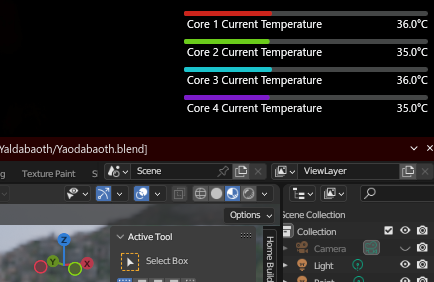
Yeah. And in my case it’s a very inefficient, old fan. One that makes louder noise (akin to a car engine idling or cranking) as soon as it gets faster trying to keep up with the CPU heat… Oh, and I forgot to mention this in my previous replies: I also know when my CPU temps raised because the cooling fan becomes more noisy.
I don’t know, but it intrigues me so I’ll keep a closer eye on it just out of mild curiosity.
We often underestimate how much computing power the Web have been demanding from our personal devices. Web browsers have became full-fledged Operating Systems inside whatever Operating System the user uses, and some websites are massive in terms of CPU and RAM requirements. I mean, nowadays we have video editors, graphic suites, 3D suites, even 3D games, running entirely in browser…





Adding to the replies, uppercase letters have lower hexadecimal values than lowercase in the ASCII table. For example, 0x4C is uppercase L, while 0x6C is lowercase L.
Mathematically, uppercase + 0x20 = lowercase.
Alphabetically, 41 to 4f = A to O, then 50 to 5a = P to Z; 61 to 6f = a to o, then 70 to 7a = p to z. (Believe it or not, I’m typing this from meat memory, as I kind of managed to memorize it and I can even 74 79 70 65 20 6c 69 6b 65 20 74 68 69 73 as if it were a second language; it’s thanks to mnemonic shortcuts such as alpha and Omega A to O, “PTZ” p to z, among other crazy pattern matching my ND brain often does).
Back in the DOS/MS-DOS times, RAM and (floppy) disk were very small (a floppy disk had <2MB, and I’m talking about the “modern” floppy disks from the 2000s), so there was this thing called “code golfing” in which programmers used to do some arcane math-magick to conjure as many bytes as possible from inside a single byte. Things like “packed” game sprite channels, side channel data (wonder how compression algorithms got created?), etc. They wouldn’t and often couldn’t “throw more hardware at the problem” like we’re used to nowadays. Sparing the 3rd most significant bit (01x1 1010, Z if x = 0, z if x = 1) would allow for side-channel data such as visual formatting (e.g. whether the character is selected in a terminal emulator).
This all likely played a role when they got chosen as the default interval for alphabet letters back then. Also, decimal numbers, 0x30 to 0x39 (resp. 0 to 9) are closer to the uppercase letters than to the lowercase letters, and so are most of the punctuation (which I didn’t get to memorize yet, but I remember they’re scattered across 0x21 to 0x2f then 0x3a to 0x3f then 0x5b to 0x5f).
This legacy kind of still lingers nowadays, for example, in PC keyboards whose key codes for alphabet letters (afaik) map to the 0x41 to 0x5a range when it gets to the HID driver. Then there are also devices in which program logic is burned into IC chip, such as “old” digital cameras and camcorders, so they ended “frozen” in a time where the file extension was conventionally uppercase.
(And, no, I’m not a millennial, although I’m almost one, sitting at the very cusp between them and Zs, two generations who saw the transition from analog to digital tech during our childhoods/teens).
!nostupidquestions@lemmy.world